A bitcoin block is a bundle of transactions that the network has agreed on, stamped with a short header that points back to the block before it. Blocks are added roughly every ten minutes, and the whole stack of them, in order, is what people call the blockchain.
If you have ever wondered what a blockchain is, what "block height" means or what is special about block 0, this guide covers each in plain English, starting with the smallest piece and building up.
What is inside a bitcoin block?
Picture a page in a very long ledger. Each page has two parts:
- A list of transactions. The first one is special: the coinbase transaction, which pays the miner the newly created coins plus the fees. Everything after it is ordinary payments that people sent.
- A header. The header is only 80 bytes, and it summarizes the page in six fields: a version number, the fingerprint of the previous block, a fingerprint of all the transactions inside, a timestamp, the difficulty target in compact form and a nonce.
The fingerprint in question is a hash. A hash function turns any amount of data into a fixed-length string that looks random, and changing even one character of the input changes the whole output. The transactions get squeezed into one fingerprint (a Merkle root) that sits in the header, so the 80-byte header stands in for the entire page of payments.
The nonce is the number a miner keeps changing while searching for a header whose own hash falls below the target. That search is the proof of work, which we explain separately in how proof of work works.
What is a blockchain?
A blockchain is what you get when every block carries the hash of the block before it. Block 5 contains a fingerprint of block 4, block 4 contains one of block 3, and so on back to the very first block. The blocks are chained by their fingerprints.
That chaining is why history is so hard to rewrite. Suppose someone altered a payment in an old block. The block's fingerprint would change, which would break the link in the next block, which would change that block's fingerprint, and so on all the way to the newest one. To make the edit stick, they would have to redo the work for every block after it faster than the whole network adds new ones.
There is no central server holding this chain. Every full node keeps its own copy and checks each new block against the rules before accepting it, which you can read about in what is a bitcoin node. So when people say "the blockchain," they mean a list of blocks that thousands of computers hold and verify independently.
What does block height mean?
Block height is a block's position in the chain, counted by how many blocks come before it. It is the simplest way to point at a specific moment in bitcoin's history.
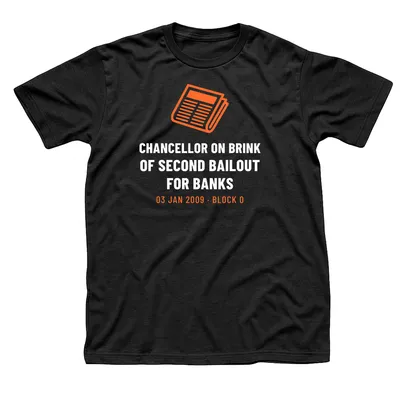
- Block 0 is the genesis block. It sits at height 0 because nothing comes before it. It was mined on January 3, 2009, and its hash begins with ten zeros. Our genesis block guide tells the story, including the newspaper headline tucked inside.
- Each new block adds 1. Block 1 is height 1, and so on. With roughly 144 blocks a day, the height climbs by about 1,000 a week.
- Today. In early October 2026 the chain is past block 970,000, according to the mempool.space block explorer.
Because height is just a counter, bitcoin uses it for scheduling instead of calendar dates. The reward halves at every 210,000th block, and the next one is expected at height 1,050,000. That is why nobody can name the day in advance, as covered in our guide to the next bitcoin halving.
How big is a block, and how many transactions fit?
A block is limited by weight, not just by size. The cap is 4,000,000 weight units, which equals about 1,000,000 virtual bytes of ordinary transaction space, and the real size on disk can run above 1 MB because of how newer transactions are counted. Every miner and node enforces this limit, so a block that exceeds it is rejected.
The number of transactions varies a lot, since payments come in different shapes. In a look at ten consecutive blocks in early October 2026, the count ranged from about 2,700 to about 7,100 transactions per block, even though every one of them was almost completely full. Because room is limited, fees decide who gets in, which we explain in bitcoin transaction fees explained.
How often is a new block found?
The target is one block about every ten minutes on average, or around 144 a day. Individual gaps are random: sometimes two blocks arrive within a minute, sometimes you wait half an hour. The network steers the average by changing mining difficulty about every two weeks, which is the subject of our guide on the bitcoin difficulty adjustment.
What is a confirmation?
When your transaction lands in a block, it has one confirmation. Each block mined on top of that adds another. The more blocks stacked above it, the less likely it can ever be reversed. Six confirmations is the commonly cited rule of thumb, though the Bitcoin Wiki calls the number arbitrary and notes that merchants selling expensive goods often wait longer. A transaction that is still waiting in line is not in any block yet, which is where the mempool comes in.
Block puns on black tees
Blocks make surprisingly good material for jokes, and a few of our designs lean on them:
- The Genesis Block tee prints the date and the block number of the very first one.
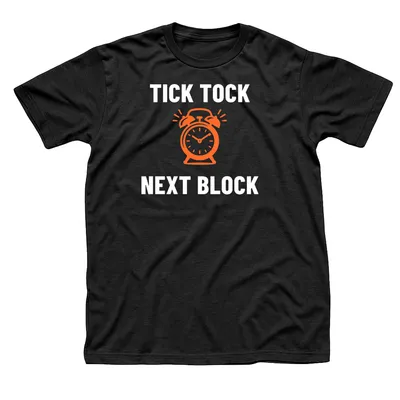
- The Tick Tock Next Block tee is for anyone who finds the ten-minute rhythm calming.
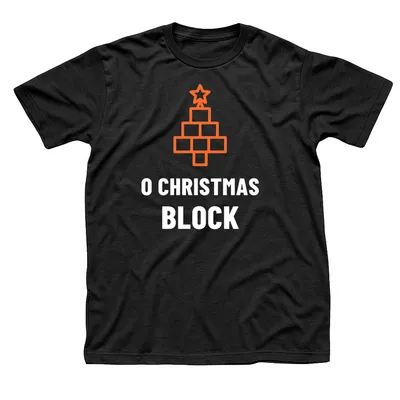
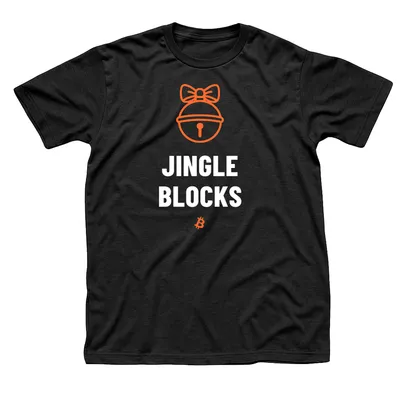
- For December, the O Christmas Block tee turns a carol into a stack of blocks shaped like a tree, and the Jingle Blocks tee swaps the bells in a sleigh-ride song for blocks.
You can see them next to the rest of the bitcoin history shirts and the full bitcoin t-shirts collection.
Sources: Bitcoin Wiki, Block hashing algorithm for the header fields, Bitcoin Wiki, Confirmation, and the mempool.space explorer for block 0 and recent block data.