The next bitcoin halving is expected around April 2028, when the network reaches block 1,050,000 and the reward for mining a block falls from 3.125 BTC to 1.5625 BTC. Nobody can name the exact day in advance, because the halving is triggered by a block number, not by a date on the calendar.
That answers the short version. The rest of this guide explains what the halving actually is, lists every bitcoin halving date so far, shows how a halving countdown is calculated, and covers what changes (and what doesn't) once the reward drops.
What is the bitcoin halving?
Every new bitcoin enters circulation through mining. When a miner adds a block to the chain, the rules let them pay themselves a set amount of brand new coins, called the block subsidy or block reward, plus the fees attached to the transactions in that block. The halving is the rule that cuts the new-coin part in half every 210,000 blocks.
When the network launched in January 2009, each block paid 50 BTC. The subsidy has been cut four times since then, and it will keep shrinking until it rounds down to zero around the year 2140. That steady cut is the whole reason the total supply can never pass 21 million coins. If you want the arithmetic behind the cap, our guide on why there are only 21 million bitcoin walks through it step by step.
It helps to know what the halving is not. It is not a vote, a company announcement or a switch that someone flips. It is written into the rules that every node on the network checks for itself. Once block 1,050,000 arrives, nodes will simply reject any block that tries to pay its miner more than 1.5625 new BTC.
Bitcoin halving dates so far
Here is the full history of the block reward, starting with the very first block:
- January 3, 2009, the genesis block: 50 BTC per block. The story of that first block is in our genesis block guide.
- First halving, November 28, 2012 (block 210,000): 50 BTC to 25 BTC.
- Second halving, July 9, 2016 (block 420,000): 25 BTC to 12.5 BTC.
- Third halving, May 11, 2020 (block 630,000): 12.5 BTC to 6.25 BTC.
- Fourth halving, April 20, 2024 (block 840,000): 6.25 BTC to 3.125 BTC.
- Fifth halving, expected around April 2028 (block 1,050,000): 3.125 BTC to 1.5625 BTC.
Look closely at the gaps. None of them is exactly four years. The first took about three years and seven months, and each one since has landed a little closer to the four-year mark. That pattern is the key to the next question.
Why nobody can give you an exact date
Bitcoin aims for one block roughly every 10 minutes. Multiply 210,000 blocks by 10 minutes and you get about 1,458 days, which is just under four years. That is where the "every four years" rule of thumb comes from.
Real block times wander, though. Finding a block is a numbers game, so some arrive in two minutes and some take half an hour. The network corrects for this every 2,016 blocks, roughly every two weeks, by raising or lowering the mining difficulty so the average drifts back toward 10 minutes. When lots of new mining power joins between those corrections, blocks come a little faster than planned, which is why every halving so far has arrived ahead of the four-year mark.
So any site that shows you an exact day and hour years ahead is projecting from today's pace, and that projection will move. "Expected around April 2028" is the honest answer for now. The estimate tightens over the final weeks, and on the day itself you can watch the block height tick over in real time.
How a halving countdown works
You can build your own bitcoin halving countdown with two numbers and a calculator:
- Find the current block height. Any public block explorer shows it on its front page.
- Subtract it from 1,050,000 to get the blocks remaining.
- Divide by 144, the number of 10-minute blocks in a day, to get an estimate in days.
As a made-up example, if the chain were at block 950,000, there would be 100,000 blocks left, or about 694 days. Countdown widgets on bitcoin sites do the same math, sometimes with a smarter guess at future block times. The answer to "how many days since the bitcoin halving" works the other way: count forward from April 20, 2024.
Bitcoiners have a phrase for this steady, indifferent rhythm: tick tock, next block. Headlines come and go, prices jump around, and the chain just keeps adding blocks at its own pace until the next halving shows up.
What changes after a halving, and what doesn't
What changes is the flow of new coins. At 144 blocks a day, the current subsidy of 3.125 BTC adds about 450 new bitcoin per day. After the 2028 halving, that drops to about 225. Miners feel it most, since half of their new-coin income disappears overnight. Some older, less efficient machines may get switched off, and the difficulty adjustment then rebalances the network. Over the long run, transaction fees are meant to make up a growing share of what miners earn.
What doesn't change is just as important:
- Coins you already hold stay exactly where they are. A halving never touches existing balances.
- Sending and receiving keeps working the same way, before and after.
- One bitcoin is still 100,000,000 sats. If that unit is new to you, read how many sats are in a bitcoin.
- The 21 million limit stays where it has always been.
Halvings and price talk
Halvings come up constantly in price discussions, because people like to compare what the market did in the months after each one. Keep two things in mind. Four halvings is a tiny sample, and the market around bitcoin looks very different today than it did in 2012. Past performance says nothing about the future. We don't make price predictions, and nothing in this guide is financial advice.
Wear the schedule
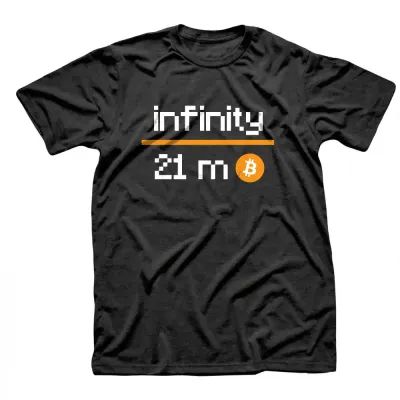
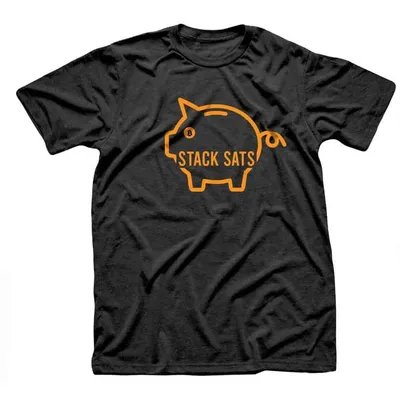
If the halving is your favorite piece of bitcoin trivia, a couple of our tees speak the same language. The Infinity / 21M tee prints the famous fraction, everything over 21 million, which only works because the halvings eventually stop issuance. The Stack Sats tee suits anyone who answers a shrinking block reward by quietly adding a little more each week. You can browse the rest in our bitcoin meme shirts collection, all printed on black tees and shipped from the USA.
Sources: Bitcoin Wiki, Controlled supply for the halving heights and dates, and the Bitcoin white paper for how mining and new coins work.