Bitcoin is capped at 21 million because its code pays out new coins on a shrinking schedule: 50 bitcoin per block at first, cut in half every 210,000 blocks, and those halving payouts add up to just under 21 million in total. Satoshi Nakamoto picked the starting numbers and later called the result an educated guess.
So the 21 million bitcoin limit is not a rule someone enforces from an office. It is the sum of a math series that every bitcoin node checks, block by block.
The math, made simple
New bitcoin enter circulation as a reward for the miner who adds each block. Blocks arrive roughly every ten minutes, and every 210,000 blocks, roughly every four years, the reward halves. That event is called a halving.
Add up each era:
- First era: 210,000 blocks × 50 BTC = 10,500,000 BTC.
- Second era: 210,000 × 25 = 5,250,000 BTC.
- Third era: 210,000 × 12.5 = 2,625,000 BTC.
- And so on, each era adding half of the one before.
That is a geometric series: 10.5 million plus 5.25 million plus 2.625 million and onward. Each step closes half of the remaining gap to 21 million, so the total keeps getting closer to 21 million without ever passing it. It is like walking halfway to a wall, then half of what is left, then half again.
There is one extra wrinkle. Bitcoin can't be split below one satoshi, which is one hundred millionth of a bitcoin. When the halving rewards get tiny, the fractions below a satoshi get rounded away. The Bitcoin Wiki puts the true maximum at about 20,999,999.9769 BTC (controlled supply), a hair under 21 million.
Halvings so far
Here is the reward schedule to date:
- 2009: 50 BTC per block, starting with the genesis block.
- November 2012: first halving, down to 25 BTC.
- July 2016: second halving, down to 12.5 BTC.
- May 2020: third halving, down to 6.25 BTC.
- April 2024: fourth halving, down to 3.125 BTC.
- Around April 2028: the next halving is expected at block 1,050,000, cutting the reward to 1.5625 BTC.
Block times vary, so the next date is an estimate, not a fixed day. Our guide to the next bitcoin halving tracks it in more detail.
How many bitcoin are left?
The 20 millionth bitcoin was mined in March 2026, which means fewer than 1 million bitcoin are left to mine. Because the reward keeps halving, that last million will trickle out over more than a century.
The curve is steep at the start and almost flat at the end. Roughly half of all bitcoin were mined in the first four years. The last few hundred thousand will take decades.
There is also a quieter number: bitcoin that exists but can never move again. Early coins on lost hard drives and forgotten keys are still counted in the supply but are out of reach forever. Nobody has a reliable count, so be wary of any precise figure you see.
What happens when all bitcoin are mined?
The last fraction of a bitcoin is expected to be mined around 2140. After that, miners stop receiving new coins and earn only the transaction fees people attach to their payments.
Satoshi planned for this in the white paper. Section 6, on incentives, says that once a set number of coins have entered circulation, the reward can move entirely to transaction fees (the bitcoin white paper). Whether fees alone will be enough to keep mining secure is one of the long-running debates in bitcoin, and there are still more than a hundred years to watch it play out.
Interestingly, the number 21 million does not appear in the white paper at all. It only exists in the code.
Why 21 million and not some other number?
Satoshi never published a full explanation, but in an email to developer Mike Hearn he called the coin count and schedule an educated guess. He wrote that he wanted prices to be roughly similar to existing currencies, which is hard to aim for when you can't see the future, and that he ended up choosing something in the middle.
Plenty of theories try to find a hidden meaning in the number. Most are fun, and none is confirmed. The plainer explanation is that 50 coins per block, a four-year halving cycle and ten-minute blocks together produce 21 million.
Can the 21 million cap change?
Technically, the rules live in software, so in theory people could run software with different rules. In practice it is extremely hard, because every full node checks every block on its own. A block that pays out more than the schedule allows is rejected by those nodes, no matter who mined it.
There is even a real example. On August 15, 2010, a bug let someone create about 184 billion bitcoin in a single transaction. Within about five hours, a fixed version of the software was released, and the network moved to a corrected chain that left those coins out.
To raise the cap today, a large share of users, businesses and miners would all have to agree to run new rules, and anyone who disagreed could keep running the old ones. Since the fixed supply is a big part of why people value bitcoin at all, that agreement is very unlikely. Nothing here is financial advice, just how the system works.
The 21 million on a shirt
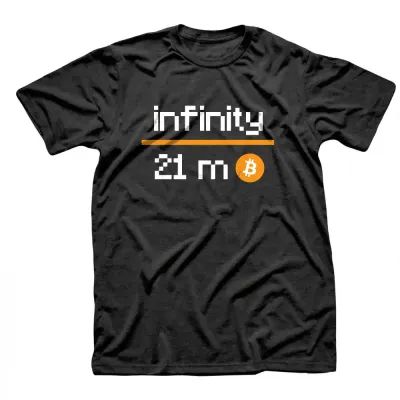
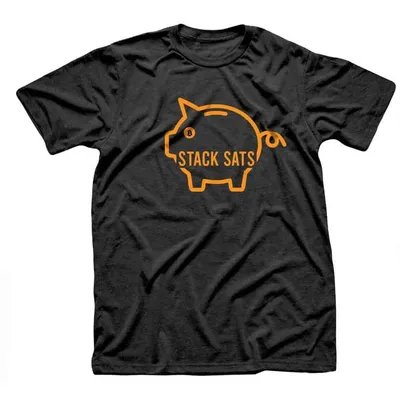
Bitcoiners love this number, and it shows up on a lot of merch. Our Infinity / 21M tee prints the classic joke where infinity sits over 21 million like a fraction: everything, priced in a fixed supply. For the saver's angle, the Stack Sats tee puts the habit of collecting small amounts on an orange piggy bank, and No 2nd Best spells out the maximalist view in stacked letters. All three are black tees, printed to order.