Bitcoin mining is the process of using computing power to compete for the right to add the next block to the blockchain. The winning miner is paid in newly issued bitcoin plus the fees from the payments in that block, and the competition is also what keeps the ledger secure.
A bitcoin miner can mean the person or company doing this, or the machine itself. This guide explains how bitcoin mining works in order: what miners actually do, how rewards and difficulty are set, what the hardware is like in general terms, and what is known about the energy involved. If you are new to the topic, bitcoin basics for beginners gives the wider picture.
What a bitcoin miner actually does
Miners do two jobs. First, they gather payments that are waiting to be recorded and assemble them into a candidate block. Second, they repeat a guessing routine, changing a number in the block's header and running it through a fingerprint function over and over, hunting for a fingerprint that falls below the network's current target. The first miner to find one broadcasts the block.
Mining does not decide which payments are legal. Every node on the network checks the new block against the rules, and a block that breaks them is rejected, which makes all that effort worthless. So miners propose and nodes dispose. The guessing routine is called proof of work, and our proof of work guide covers it in detail.
How miners get paid
A winning block pays its miner in two parts:
- The block subsidy. This is brand new bitcoin created by the block. It was 50 BTC at the start in 2009 and has been cut in half four times. Since the halving of April 2024 it has been 3.125 BTC per block.
- Transaction fees. Senders attach a fee to each payment, and the miner keeps the total from every payment in the block.
The next cut is expected around April 2028, at block 1,050,000, taking the subsidy to 1.5625 BTC. The schedule continues until the subsidy runs out around the year 2140, after which fees are the only income. Our next bitcoin halving guide has the full list of dates.
A newly mined reward cannot be spent right away. The rules make it wait for 100 more blocks, so a miner cannot spend a reward from a block that later gets replaced.
How difficulty works
If more computers join the race, blocks would arrive faster than every ten minutes. Bitcoin prevents that with a self-adjusting target. Every 2,016 blocks, roughly two weeks, the network compares how long those blocks really took with the ten-minute goal and makes the next batch harder or easier. This is called the difficulty adjustment, and we explain it in bitcoin difficulty adjustment explained.
To give a sense of scale, public trackers in early October 2026 showed a difficulty of about 132.7 trillion and a network speed near 980 exahashes per second. An exahash is a billion billion guesses, so that works out to nearly a sextillion guesses every second, worldwide. Hash rate estimates vary a little from site to site and move daily, so treat these as a snapshot.
What bitcoin mining hardware looks like
Early on, anyone could mine on an ordinary computer. As more people joined, the competition pushed miners to ever faster hardware. In general terms, the sequence went from regular processors to graphics cards, then to programmable chips, and then around 2013 to ASICs, short for application-specific integrated circuits. An ASIC miner is a machine built to do one job, running bitcoin's fingerprint function at enormous speed, and it cannot do much else.
Without naming brands, here is what to expect of a modern mining machine:
- Speed is measured in hashes per second. Today's machines are rated in terahashes per second, meaning trillions of guesses.
- Efficiency matters as much as speed. It is usually quoted in joules per terahash, so a lower number means less electricity for the same work.
- It is loud and hot. The machine pulls a lot of power and needs strong cooling, which is why mining is usually done in warehouses or purpose-built sites rather than living rooms.
- It needs cheap, steady electricity. Power is typically the biggest ongoing cost.
Whether any particular setup makes or loses money depends on hardware prices, electricity costs, difficulty and fees, all of which change. Nothing here is a recommendation to mine or buy equipment.
Mining pools and solo mining
Because the odds for one machine are so small, most miners join a pool. Everyone in the pool combines their hash power, and when the pool finds a block, the reward is shared out in proportion to the work each member contributed. Payouts become small and regular, instead of rare and large. A solo miner keeps the full reward from any block found, but may go years between wins, if ever.
How much energy does bitcoin mining use?
Because mining turns electricity into security, it draws a lot of power, and people hold very different views on whether that is a flaw or a feature. Here is what a major academic source reports.
The Cambridge Centre for Alternative Finance published a Digital Mining Industry Report in April 2025, based on a survey of miners that covered about 48 percent of global mining activity. It estimated annual electricity use at about 138 terawatt-hours, around 0.5 percent of global electricity consumption. It found that 52.4 percent of the energy used came from sustainable sources, led by hydropower, wind and nuclear. Natural gas was the largest single source at 38.2 percent, and coal was 8.9 percent.
Estimates differ depending on the method and the date, and the network keeps changing, so look for the latest report before quoting a number.
How many bitcoin are left to mine?
By our count of the issuance schedule, a little over 20 million of the 21 million bitcoin had been issued by early October 2026, which leaves roughly 900,000 still to come. Because each halving shrinks the rewards, those last coins are released slowly over more than a century. For the maths behind the cap, read why there are only 21 million bitcoin.
Wear the mining life
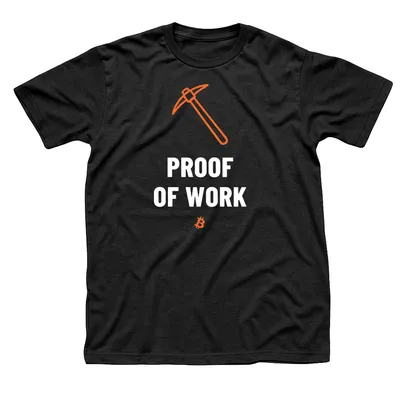
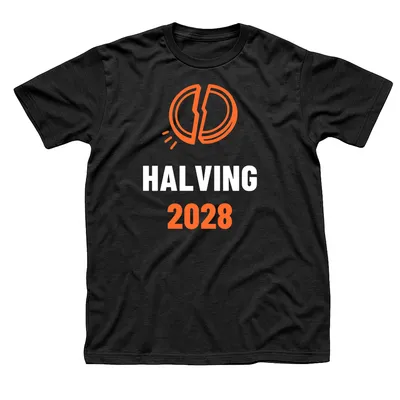
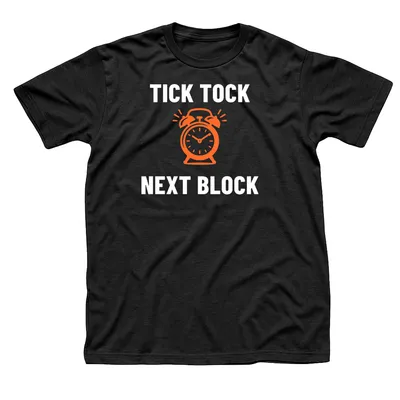
The Proof of Work tee swings an orange pickaxe above its name in big white capitals, a good fit for anyone who treats the grind as a virtue. The Halving 2028 tee shows an orange coin split into two drifting halves above the date it is expected. And the Tick Tock, Next Block tee features a ringing orange alarm clock for people who keep one eye on the block height. Each is a black unisex tee, and you can browse more in our bitcoin tech shirts collection.
Sources: Cambridge Judge Business School on sustainable energy in bitcoin mining, mempool.space mining statistics and the Bitcoin developer guide on the block chain.