Quick add · pick a size
Magic Internet Money
Unisex tee · XS–3XL
$39.99
 Hover to zoom
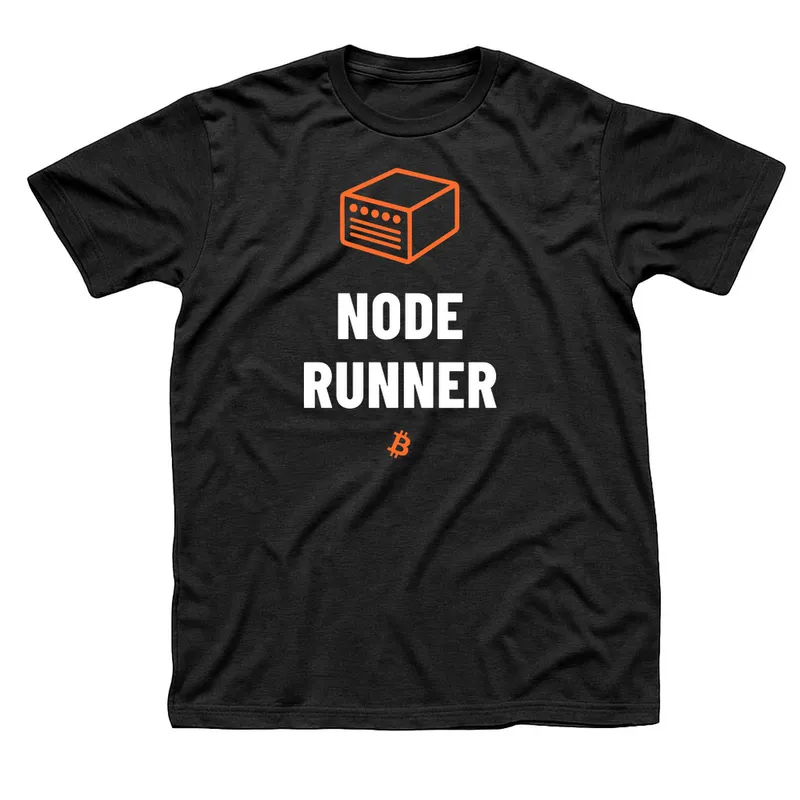
For people who run their own bitcoin node and check every block themselves.
An orange outline of a small server box with a row of round status lights and vent slots sits above NODE and RUNNER in two lines of big white capitals.
| Material | Airlume combed & ring-spun cotton |
|---|---|
| Fit | Unisex tailored crew neck |
| Printed to order | |
| Sizes | XS, S, M, L, XL, 2XL, 3XL |
| SKU | BC-NODE |
Ships in 3–4 business days, tracked. See the shipping policy and returns & exchanges.
Some bitcoiners keep a small computer humming in a closet, checking every block on their own. This tee gives them a title.
A bitcoin node is a computer running software that downloads the blockchain and enforces bitcoin's rules on every block and transaction it sees. Thousands of people around the world run one at home, often on a small dedicated box. Nodes earn no rewards the way miners do; operators run them to verify their own payments, protect their privacy and add one more independent voice to the network. Node runner is the community's badge of honor for doing that work.
Made for home lab tinkerers, privacy nerds and anyone with a blinking box on a bookshelf. The server drawing is clean and graphic, so the shirt reads as tech-savvy rather than loud. Great for hackathons, bitcoin meetups and IT departments.
Not necessarily. Many people use a spare laptop or a small single-board computer with enough storage for the blockchain, which takes several hundred gigabytes. Free node software and ready-made node kits make the setup approachable for non-experts.
A miner spends electricity to produce new blocks and earn rewards. A node runner checks those blocks against the rules and rejects any that break them. Mining needs specialized machines, while a node can run on modest hardware at home.
They are status lights, the little indicators that blink on almost every piece of network gear. Together with the vent slots, they make the box read instantly as a computer that is always on, which is exactly what a node is.
Quick add · pick a size
Unisex tee · XS–3XL
Quick add · pick a size
Unisex tee · XS–3XL
Quick add · pick a size
Unisex tee · XS–3XL