A Cypherpunk's Manifesto is a one-page essay by mathematician and programmer Eric Hughes, dated March 9, 1993, which argues that privacy in a networked world will not be granted by governments or companies, so people must protect it themselves with cryptography and software. Its most quoted line, "Cypherpunks write code," became the motto of a mailing list whose members spent the next fifteen years on the ideas that bitcoin eventually pulled together.
This guide walks through what the manifesto actually says, who the cypherpunks were, and the precursors to bitcoin that came out of their circle, sticking to what the record shows.
What the cypherpunk manifesto says
The essay is short enough to read in five minutes, and it builds one argument step by step.
- Privacy is not secrecy. Hughes draws a line between the two. A secret is something you want nobody to know. Something private is something you choose to reveal only to some people. As he puts it, "Privacy is the power to selectively reveal oneself to the world."
- Transactions leak identity. When you buy a magazine with cash, the clerk does not need your name. Electronic systems tend to reveal who you are by default, and that is where privacy is lost.
- So an open society needs anonymous transaction systems, and until then, cash had been the main one. This is the passage bitcoiners point to most, because it treats digital cash as a privacy tool, not just a payment method.
- Nobody will hand privacy over. Large organizations benefit from talking about us, Hughes writes, so "We must defend our own privacy if we expect to have any."
- Code is the answer. Cypherpunks publish free software that anyone can use, on the theory that widely distributed software is very hard to stamp out.
- Laws stop at borders. Rules against cryptography reach only as far as a country's borders, while the math travels everywhere.
It closes with an invitation to work together and a single word: "Onward."
Cypherpunks write code meaning
The phrase is a statement about method. Instead of lobbying for privacy, asking companies to behave or writing manifestos only, the cypherpunks believed the most reliable protection was working software that nobody could take back once it was released. In the essay, Hughes explains that someone has to write the software that defends privacy, and since nobody gets privacy unless everybody does, the cypherpunks would write it.
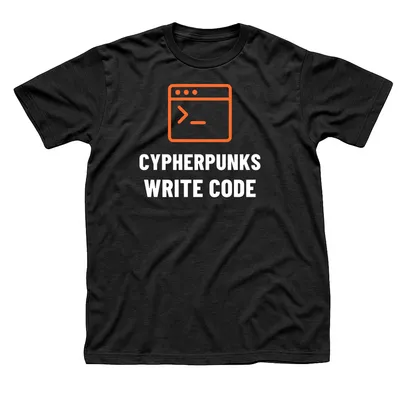
The idea lives on in open source culture and especially in bitcoin, where a lot of the community's respect goes to people who build things, test things and run their own nodes rather than people who only talk. It is also why the line works on a shirt: our Cypherpunks Write Code tee prints it under an orange terminal window with a blinking cursor.
Who were the cypherpunks?
In late 1992, Eric Hughes, Timothy C. May and John Gilmore started a small group that met monthly in the San Francisco Bay Area, at the offices of Gilmore's company, Cygnus Solutions. At one of the first meetings, the writer and hacker Jude Milhon jokingly called them cypherpunks, a blend of cipher and cyberpunk, and the name stuck.
The group soon had a mailing list, run on Gilmore's toad.com server, so people far beyond California could join in. By 1997 it was estimated to have around 2,000 subscribers. The list mixed serious mathematics, policy debate, flame wars and plenty of noise, and it became the meeting place for an unusual mix of cryptographers, engineers, activists and libertarians.
The press noticed quickly. The May/June 1993 issue of Wired carried Steven Levy's article Crypto Rebels, and its cover showed Hughes, May and Gilmore wearing masks. People who took part in the list over the years include Hal Finney, Adam Back, Wei Dai and Nick Szabo, all names that come up again in bitcoin's story.
Tim May and the Crypto Anarchist Manifesto
Tim May, a former Intel engineer, brought an earlier and more radical text. He had written The Crypto Anarchist Manifesto in mid-1988 and handed it out at a cryptography conference that year. He read it aloud at the cypherpunks' founding meeting in September 1992 and posted it to the list that November. It opens: "A specter is haunting the modern world, the specter of crypto anarchy."
Where Hughes wrote about privacy, May wrote about power. He predicted that anonymous communication and digital money would change how governments tax and regulate economic life. In 1994 he expanded his ideas into the Cyphernomicon, a long FAQ for the list. May died in December 2018.
The crypto wars backdrop
The manifesto was not written in a vacuum. In the early 1990s the US government treated strong encryption software as a munition for export purposes. Phil Zimmermann released PGP, free email encryption software, in 1991, and in February 1993 he became the target of a criminal investigation over its spread abroad. The case was closed in 1996 without charges. In 1995 he even had the source code printed as a book, since books enjoy free speech protection. In 1993 the government also proposed the Clipper chip, an encryption chip built so that officials could recover the keys.
To the cypherpunks, all of this proved their point: rights that depend on permission can be withdrawn, and published code cannot.
The path to bitcoin
Digital cash was a cypherpunk obsession from the start, and several attempts came before bitcoin. Each one solved part of the puzzle.
- David Chaum's ecash. Chaum's research in the 1980s showed how cryptography could make digital payments private. His company, DigiCash, ran trials in the 1990s but depended on a central issuer, and it went bankrupt in 1998.
- Hashcash, 1997. Adam Back announced Hashcash on the cypherpunks list on March 28, 1997. It made the sender of an email do a small amount of computing work that anyone could check instantly, as a defense against spam. That idea, proof of work, became bitcoin's engine, as our proof of work guide explains.
- b-money, 1998. Wei Dai proposed an anonymous, distributed electronic cash system and shared it with the cypherpunks list. His write-up opens with a nod to the list's founder: "I am fascinated by Tim May's crypto-anarchy."
- Bit gold, 1998. Nick Szabo designed a scheme in which solved computing puzzles would be chained together and recorded as scarce digital property. It was never implemented, and he described it publicly on his blog in 2005.
- RPOW, 2004. Hal Finney built reusable proofs of work, a working system for passing proof of work tokens from person to person, though it still relied on a server.
In October 2008, Satoshi Nakamoto shared the bitcoin white paper on the Cryptography mailing list, a later list that drew many of the same people. The paper cites both b-money and Hashcash, and Wei Dai and Adam Back were among the first people Satoshi contacted. In July 2010, Satoshi wrote on BitcoinTalk that "Bitcoin is an implementation of Wei Dai's b-money proposal" and of Szabo's bit gold. Dai himself has since questioned how much b-money actually shaped bitcoin. Either way, the new part was the combination: proof of work plus a public chain that every node checks, with no central issuer at all. Our plain-English summary of the white paper goes section by section.
Cypherpunk, cyberpunk or CryptoPunks?
The words get mixed up constantly. Cyberpunk is a science fiction genre about high technology and street-level rebellion. Cypherpunk, from cipher, means someone who uses cryptography to protect privacy and freedom, and specifically a member of that 1990s mailing list. CryptoPunks is an unrelated collection of pixel art NFT characters launched in 2017. If you searched for a cryptopunk shirt and meant the privacy movement, cypherpunk is the word you want.
Shirts with cypherpunk roots
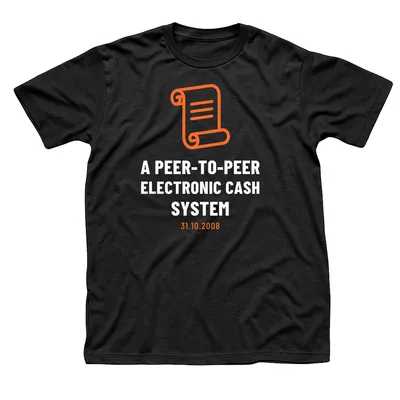
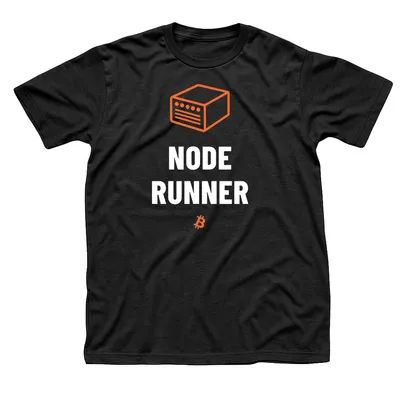
Besides the Cypherpunks Write Code tee, a few of our designs carry the same spirit. The Node Runner tee is for people who verify every block on their own machine, the Don't Trust, Verify tee puts the check-it-yourself rule under an orange magnifying glass, and the White Paper tee prints the subtitle of the document that brought these threads together. Each is printed on a black unisex tee when you order, and the full range sits on our Bitcoin history shirts page.
Sources: A Cypherpunk's Manifesto by Eric Hughes, Wikipedia on the cypherpunk movement and Satoshi's July 20, 2010 BitcoinTalk post via the Satoshi Nakamoto Institute.