Don't trust, verify means you check the facts yourself instead of relying on someone else's word, and in bitcoin it usually means running software that checks every block and transaction against the rules on your own machine. The phrase is a twist on "trust, but verify," a Russian proverb that Ronald Reagan used again and again during nuclear arms talks with the Soviet Union.
It sounds like a slogan, but it describes how the network actually works. Here is where the words came from, what verifying looks like in practice and where the motto gets stretched too far.
From a Russian proverb to a Cold War catchphrase
The original saying is Russian: doveryai, no proveryai, which rhymes in Russian and translates as trust, but verify. It reached American politics through Suzanne Massie, a writer on Russian history who met with President Reagan several times between 1984 and 1987. She suggested he learn a few proverbs, since Russians like to talk in them.
Reagan took the advice to heart. He used the line so often in talks with Mikhail Gorbachev that it became a running joke between them. When the two leaders signed the Intermediate-Range Nuclear Forces Treaty on December 8, 1987, Reagan said it once more, and Gorbachev replied, "You repeat that at every meeting." The point was serious, though. The treaty came with on-site inspections so each side could check that the other was keeping its promises.
Why bitcoiners dropped the word trust
Bitcoin's version removes the first half of the proverb. That is not cynicism for its own sake. It reflects the problem bitcoin was designed to solve.
The 2008 white paper starts by describing how online payments rely on banks and payment companies acting as trusted middlemen. It then proposes "an electronic payment system based on cryptographic proof instead of trust." In other words, the system should work even if nobody trusts anybody, because every participant can check the evidence. Our plain-English summary of the bitcoin white paper walks through how the paper builds that idea section by section.
So when a bitcoiner says don't trust, verify, they are not telling you to distrust your neighbors. They are pointing out that with bitcoin, you don't need to.
What verifying means in bitcoin
The verifying is done by full nodes: computers running bitcoin software that download every block and check it independently. A node does not care who mined a block or how famous they are. It asks only whether the block follows the rules. Among other things, it checks that:
- Every transaction is signed by the keys that control the coins being spent.
- No coin is spent twice.
- The miner paid itself no more new bitcoin than the schedule allows, which is how the 21 million limit is enforced in practice.
- The block carries valid proof of work and links correctly to the block before it.
If anything fails, the node rejects the block, even if a large mining company produced it. That is the quiet power behind the motto. Thousands of independent nodes each saying no to a broken block is what keeps the rules from changing under people's feet. If you want the details of what a node is and how people run one at home, see our guide on what a bitcoin node is.
Many phone wallets take a shortcut. Instead of checking everything, they ask someone else's node for information. The white paper itself describes a lighter verification method and admits it is weaker, noting that businesses receiving frequent payments will probably want to run their own nodes anyway. Light wallets are convenient, but they put a little trust back into the picture.
How to verify for yourself
You don't need to be a programmer to live by the motto. A few practical habits cover most of it:
- Run your own node, or at least connect your wallet to a node you control, so your balance and payments are checked by your own copy of the rules.
- Check that the wallet or node software you download is genuine by comparing its published signatures or checksums before installing.
- Confirm receiving addresses on the screen of your hardware wallet, not just on your computer, before sharing them.
- Hold your own keys. A balance on an exchange is a promise from the exchange, which is the whole argument behind not your keys, not your coins.
- Read primary sources. When someone online makes a claim about bitcoin, look for the original document, post or code before repeating it.
None of these steps makes you an expert overnight. Each one replaces a little blind trust with something you checked yourself.
Where the motto gets stretched too far
Like any good slogan, don't trust, verify can be misused. Some people treat it as permission to doubt everything except their own opinions. That gets it backwards. Verifying means looking at the evidence and accepting the answer, even when it is not the one you wanted.
It is also worth being honest that nobody verifies everything. Most node runners have not read every line of the code. They trust the hardware they bought and the open review process behind the software. The motto is a direction, not a purity test: reduce trust where you reasonably can, and know where you are still relying on others.
That humility fits the original Cold War meaning surprisingly well. Reagan never claimed verification would make trust unnecessary between nations. Bitcoin simply went one step further for money, where checking the rules can be automated and shared by anyone with a computer.
Shirts for people who check
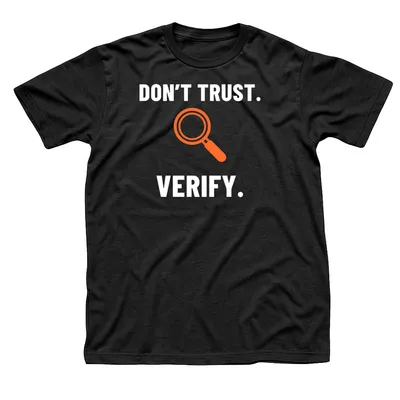
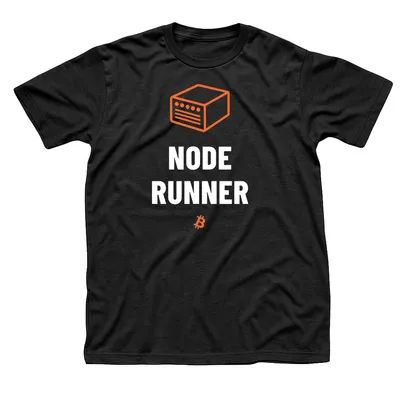
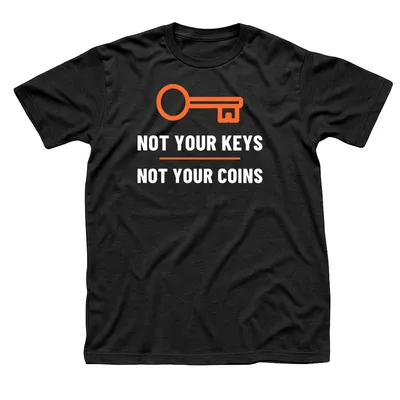
The motto has become a calling card for node runners, auditors and anyone who reads the fine print, so it made sense to print it. Our Don't Trust, Verify tee puts a tilted orange magnifying glass between the two halves of the sentence, with VERIFY set largest so the point lands first. For the person who actually keeps a node humming on a shelf, the Node Runner tee shows a small orange server box with its status lights on. And the Not Your Keys tee covers the self-custody side, with an orange key whose bow is a coin. Each one is printed when you order and ships from the USA.
Sources: the bitcoin white paper and the history of the trust, but verify proverb, including the 1987 treaty exchange.