Vires in numeris is Latin for strength in numbers. Bitcoiners adopted it as an unofficial motto in 2011, after it came up in a BitcoinTalk forum discussion about bitcoin's logo, and it spread widely once Mike Caldwell put it on his Casascius physical bitcoins.
The phrase has stuck around for good reasons. It is short, it sounds like something stamped on an old coin, and it carries two meanings at once, both of which fit bitcoin. Here is the Latin, the history and the coins, keeping to what can be checked.
Vires in numeris meaning, word by word
- Vires is the plural of vis, the Latin word for force, power or strength. The same root survives in English legal phrases like ultra vires, beyond one's powers.
- In means in, just as in English.
- Numeris comes from numerus, number. Here it is plural and in the ablative case, the form Latin uses after in when it means location.
A very literal translation would be strengths in numbers, but strength in numbers is the natural English version, and it is the one everybody uses. In classical Latin the letter V was pronounced like a W, so a Roman would have said something close to WEE-race in NOO-meh-reese. Most English speakers simply say VEER-ays, and nobody at a meetup will correct you.
Strength in numbers bitcoin: two meanings in one phrase
When the phrase was first floated for bitcoin, a BitcoinTalk member called Vladimir wrote on May 25, 2011: "It is simple and works on more than one level at the same time." Those two levels are the reason it lasted.
Strength in many people. Bitcoin has no headquarters to raid and no single server to switch off. Its resilience comes from the large number of independent participants: people running nodes that check every rule, miners competing to add blocks, developers reviewing each other's code and holders keeping their own keys. The more of them there are, the harder it is for any one party to change the rules. Our guide on what a bitcoin node is explains why each extra node matters.
Strength in mathematics. Bitcoin's security rests on numbers in a more literal sense: cryptographic signatures, hash functions, proof of work and a supply schedule fixed in code. Nobody has to trust a promise when the math can be checked.
Where the motto came from
The earliest widely cited use in bitcoin circles is a BitcoinTalk thread called New bitcoin logo, started in March 2011 by a newcomer sharing his own coin design, which grew into a long conversation about bitcoin artwork and slogans. On May 25, 2011, a member named epii floated a Latin motto, Vires in Cryptographia, strength in cryptography, and mentioned Vires in Numeris alongside it for comparison. About a quarter of an hour later, another member, Vladimir, singled out vires in numeris as his favorite, and others quickly agreed.
The thread even had an early grammar debate. Two days later, a member suggested the singular vis instead of vires, because vires looks a little like virus at a glance. The plural won anyway, and it is the form that went on to be stamped in metal.
Casascius coins: vires in numeris in brass, silver and gold
Mike Caldwell, a bitcoin user from Sandy, Utah, who went by Casascius on the forums, began selling physical bitcoins in 2011. The first ones, solid brass 1 BTC coins, appeared in September 2011. Each coin held a real bitcoin private key printed on a small piece of paper and sealed under a tamper-evident hologram sticker. If someone peeled the hologram to get at the key, it left a visible honeycomb pattern, so anyone could tell whether a coin was still loaded.
The front of the coins typically carried the Bitcoin logo surrounded by the denomination, the year and the words VIRES IN NUMERIS. Over time Caldwell offered silver rounds, gold-plated pieces and, from December 2011, a one troy ounce gold coin loaded with 1,000 BTC. For many people, a Casascius coin was the first time bitcoin felt like something you could hold.
The coins worked as bearer instruments: whoever held an unpeeled coin effectively held the bitcoin. That made them a physical version of an idea our guide on not your keys, not your coins covers in depth. Once the key was redeemed, the coin no longer had any bitcoin value, though collectors still prize them as pieces of history.
The run ended in late 2013. The Financial Crimes Enforcement Network, part of the US Treasury, told Caldwell that minting loaded coins counted as money transmission, which would require federal registration and probably state licenses. He suspended sales of items containing bitcoin on November 27, 2013. Unredeemed Casascius coins still turn up at auction and in collections, and the motto lives on wherever bitcoiners want a little Latin.
Why the motto still fits
Many national coins carry a Latin motto. US coins, for example, carry e pluribus unum, out of many, one. Vires in numeris plays a similar role for a currency with no nation behind it. It celebrates the many people who keep the network honest instead of any authority that issues it.
It also pairs naturally with other bitcoin ideas. Sound money, the subject of our guide on what sound money means, describes the supply side of the story. Vires in numeris describes the people side: a rulebook nobody can rewrite alone, because too many independent participants would have to agree.
The vires in numeris tee
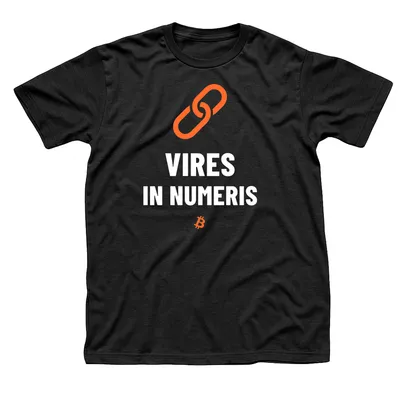
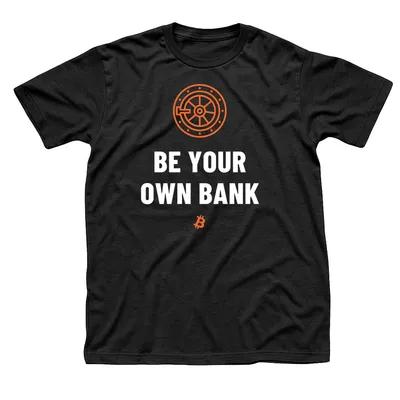
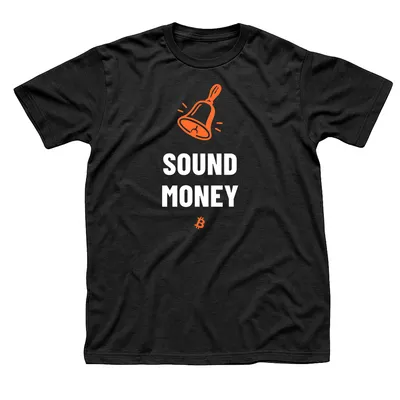
Our Vires in Numeris tee sets two interlocked orange chain links on a diagonal above VIRES in large white capitals, with IN NUMERIS a size smaller and a small orange Bitcoin symbol underneath. The chain links stand for the same idea as the motto: each one is ordinary, and together they hold. If you want a self-custody companion piece, the Be Your Own Bank tee puts an orange vault door over the phrase, and the Sound Money tee rings an orange hand bell. They are original designs printed to order on black unisex tees, and they sit comfortably with the rest of our Bitcoin history shirts.
Sources: the New bitcoin logo thread on BitcoinTalk, the Bitcoin Wiki page on Casascius physical bitcoins and CoinWeek on the first PCGS-certified Casascius coin.