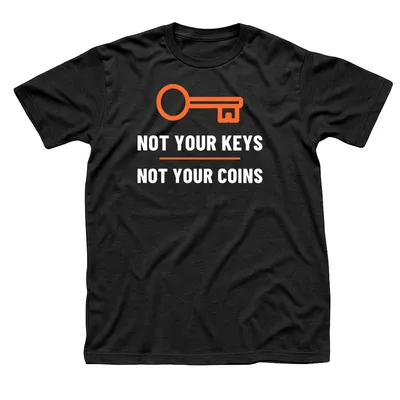
"Not your keys, not your coins" means that whoever holds the private keys to some bitcoin is the one who really controls it. If an exchange or app holds the keys for you, what you own is a promise from that company, not the coins themselves.
The phrase is a warning, a slogan and a bit of a meme all at once. This guide explains what keys actually are, who made the saying popular, what the Mt. Gox and FTX collapses taught people, and how self custody works in practice. It is educational only, not financial advice.
What a private key actually is
Bitcoin doesn't sit inside a wallet the way cash sits in a purse. The coins live as entries on the shared blockchain, assigned to addresses. What a wallet really stores is the private key, a very large secret number that lets you sign a transaction and move the coins tied to your addresses.
That is why the keys matter more than anything else. Anyone with the key can spend the coins, and without it nobody can, not even you. Most wallets back up their keys with a recovery phrase, also called a seed phrase: usually 12 or 24 ordinary words that can rebuild every key in the wallet. Those words are, in practical terms, the money.
Custodial vs self custody
There are two basic ways to hold bitcoin:
- Custodial. You keep bitcoin in an account at an exchange or app. Your balance is a number in the company's records, and the company holds the keys. Moving your coins out requires its systems to say yes.
- Self custody. You hold the keys yourself, using a software wallet on your phone or computer or a hardware wallet that keeps the keys offline. Nobody can freeze or lose your coins on your behalf.
Neither choice is free of risk. A custodian can be hacked, go bankrupt or limit withdrawals. With self custody, the risk moves to you: lose your recovery phrase and there is no password reset, and if someone tricks you into revealing it, there is no customer support line to call. The saying doesn't claim self custody is easy. It claims that only one of these options makes the coins truly yours.
Who said it first?
The idea is as old as bitcoin itself. The white paper describes a system for sending payments directly between people without going through a financial institution, which only works if people can hold their own keys. The catchy version, though, is widely credited to Andreas Antonopoulos, the bitcoin educator and author, who popularized it in his talks by pairing the two halves: if they are your keys, it is your bitcoin, and if they are not your keys, it is not your bitcoin.
The community settled on the short rhythm most people know today. You'll also see variations like "not your keys, not your crypto" and "not your keys, not your wallet," all with the same meaning.
The Mt. Gox collapse, 2014
Mt. Gox, based in Tokyo, was once the largest bitcoin exchange in the world and handled a large share of all bitcoin trading. In early February 2014 it stopped customer withdrawals. On February 28, 2014, it filed for bankruptcy protection, saying around 850,000 bitcoin were missing, most of them belonging to customers. Roughly 200,000 were later found in an old wallet.
For the customers, the coins they thought they owned turned into a claim in a bankruptcy case. Repayments didn't begin until July 2024, more than ten years later. For a generation of bitcoiners, Mt. Gox turned "not your keys, not your coins" from a theory into a lesson.
The FTX collapse, 2022
Eight years later the lesson repeated on a bigger stage. FTX was one of the largest crypto exchanges in the world. In early November 2022, a rush of customers tried to withdraw at once, the exchange froze withdrawals, and on November 11, 2022, FTX and about 130 affiliated companies filed for bankruptcy in the United States. It turned out that customer money was not where customers believed it was, and the company's founder was later convicted of fraud.
People who held their coins in their own wallets were unaffected by the freeze. People who left them on the exchange became creditors in a bankruptcy case, the same position Mt. Gox customers had found themselves in years earlier.
Self custody explained, step by step
If you're curious about holding your own keys, the general process looks like this. Take your time, and treat it as learning, not a to-do list.
- Choose a wallet type. A software wallet is free and convenient for small amounts. A hardware wallet keeps keys offline and is popular for larger savings.
- Write down the recovery phrase on paper. Store it somewhere safe and private. Never type it into a website, never photograph it, and never share it. No real support team will ever ask for it.
- Start small. Send a small amount first, confirm it arrives, and then practice sending it back out.
- Test the backup. Learn how to restore the wallet from your recovery phrase before you rely on it.
- Plan for your family. Think about how someone you trust could recover the coins if something happened to you, without making the phrase easy to steal.
Long-term holders often pair self custody with the HODL mindset. If you've never heard the story behind that word, our guide to what HODL means tells it.
Wearing the principle
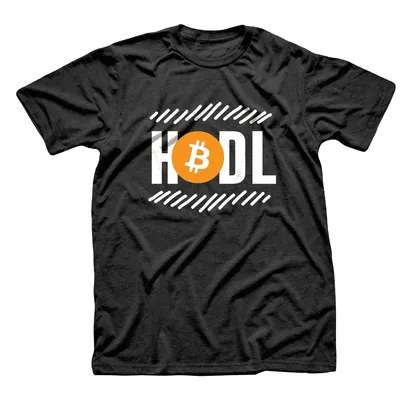
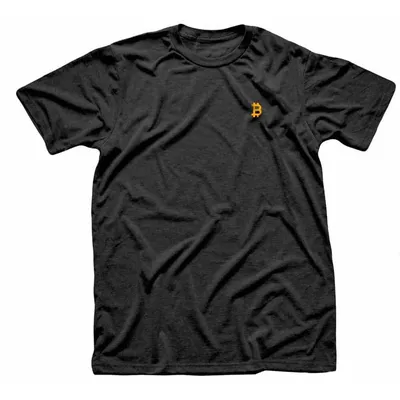
The idea behind the slogan is self-reliance, and some of our tees carry the same attitude. The HODL tee is for people who hold their coins and their nerve. The Bitcoin Logo tee, a single small orange B on the chest, is for the quiet self-custodian who doesn't need to announce how much they hold, or that they hold any at all. See more of the lineup on our bitcoin t-shirts page.
Sources: Bitcoin white paper, Wikipedia on Mt. Gox and Wikipedia on the bankruptcy of FTX.