Sound money means money that holds its purchasing power over long stretches of time because its supply cannot be expanded quickly or at someone's discretion. For most of history the phrase described gold and silver, or paper currency firmly tied to them; today bitcoiners use it for bitcoin's fixed supply, while many economists argue that steady prices matter more than a hard cap.
The phrase sounds old-fashioned because it is. Knowing where it comes from makes it much easier to follow the modern argument, so this guide starts there and then lays out both sides. Nothing here is financial advice.
What is sound money?
Think of money as a measuring stick for value. If the stick keeps shrinking, every plan that depends on it, from saving for retirement to signing a ten-year lease, gets harder. Sound money is a stick that stays roughly the same length.
People who use the term usually point to a few properties:
- Hard to make more of. New supply should be costly or strictly limited, so nobody can dilute existing holders cheaply.
- Predictable rules. Everyone can know in advance how much new money will appear and when.
- Durable, divisible and portable. It survives being stored, splits into small amounts and moves easily.
- Easy to verify. Fakes should be easy to spot.
- Widely accepted. Money only works if other people take it.
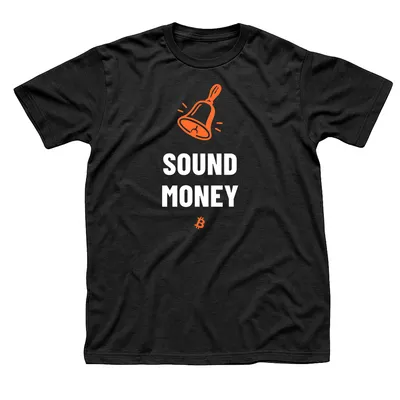
Gold scores well on the first and fourth points, which is why it dominated the conversation for centuries. The bell on our Sound Money tee is a small pun on the old phrase sound as a bell.
Where the phrase comes from
Sound money was a household phrase in nineteenth century monetary debates, and its most famous moment came in the United States in 1896. That year's presidential race turned on the money question. William Jennings Bryan, the Democratic nominee, campaigned for free coinage of silver, which would have expanded the money supply and eased the burden on indebted farmers. His Cross of Gold speech at the Democratic convention in Chicago is still studied today.
The Republicans answered with gold. Their platform, adopted in June 1896, declared the party "unreservedly for sound money" and said the gold standard must be maintained. William McKinley won the election, and in 1900 Congress wrote the gold standard into law with the Gold Standard Act.
The idea got its best-known theoretical defense from the Austrian economist Ludwig von Mises. In the 1953 edition of The Theory of Money and Credit, he described sound money as "an instrument for the protection of civil liberties against despotic inroads on the part of governments." In other words, for Mises the point was not only economic. A currency politicians cannot quietly inflate also limits how much they can spend without asking voters.
The world moved the other way. On August 15, 1971, President Richard Nixon suspended the convertibility of the dollar into gold, and since then the major world currencies have been fiat money, backed by the governments and central banks that issue them rather than by a metal.
Is bitcoin sound money? The case for
Bitcoiners revived the phrase because bitcoin's supply works more like a mined metal than a managed currency, only stricter.
- A fixed, public schedule. New bitcoin enter circulation as block rewards that halve every 210,000 blocks, adding up to just under 21 million coins. The next halving is expected around April 2028. Our guide on why there are only 21 million bitcoin explains the math.
- No issuer to lean on. There is no central bank that can decide to create more. Changing the supply rules would require the people running the network to adopt new software, and they have strong reasons to refuse.
- Anyone can check. Every full node verifies the total supply for itself, which makes bitcoin easier to audit than gold in a vault.
- Portable and divisible. One bitcoin splits into 100 million satoshis and can cross the world in minutes.
Satoshi Nakamoto framed the problem in the February 2009 post that introduced bitcoin on the P2P Foundation forum: "The central bank must be trusted not to debase the currency, but the history of fiat currencies is full of breaches of that trust." For bitcoiners, sound money is the answer to that sentence.
The case against
Critics include most mainstream economists, and their objections deserve a fair hearing.
- Volatility. Sound money is supposed to be a stable yardstick, yet bitcoin's price has swung wildly, including several drops of well over half its value. A fixed supply with shifting demand produces a shifting price.
- Unit of account. Very few prices are set in bitcoin. Most people still think, borrow and get paid in their national currency.
- The gold standard had costs too. Many economic historians argue that tying money to gold made the Great Depression worse, and that countries which left gold earlier tended to recover sooner.
- Mild inflation is a choice, not an accident. The US Federal Reserve formally adopted a 2 percent inflation target in 2012. Supporters argue that a small, steady rise in prices encourages spending and investment, gives central banks room to cut rates in a crisis and avoids the risks of falling prices.
- Scarcity alone is not enough. Plenty of things are scarce without being good money. Acceptance, legal frameworks and stability matter as well.
Bitcoiners answer that volatility is the growing pain of a young asset being priced by the whole world, and that inflation targets quietly tax savers. The debate is genuinely unsettled, and reasonable people land on both sides.
Sound money, hard money and stable money
These terms overlap but are not identical. Hard money usually means money that is costly to produce, like gold or bitcoin. Stable money means money whose purchasing power stays steady, which is what central banks aim for with low, predictable inflation. Sound money, in the Austrian tradition, combines the two hopes: a supply that cannot be manipulated, and therefore, its fans argue, value you can rely on over the long run. Critics reply that a hard supply and stable prices do not always go together.
How bitcoiners use the phrase today
In everyday bitcoin talk, sound money works as a compact worldview. You will see it in podcast titles, conference talks and replies under news about inflation. It often travels with related ideas, especially the claim that money which holds its value encourages patience and long-term planning, the subject of our guide to low time preference. It also has a playful side, as in the meme number go up, which our number go up guide unpacks.
Shirts for sound money fans
Our Sound Money tee shows a ringing orange hand bell over the phrase, with a small Bitcoin symbol below. The Infinity / 21M tee is the math version of the argument, everything divided by 21 million. The Low Time Preference tee covers the patience side, and the Vires in Numeris tee adds a Latin motto from bitcoin's early collector coins. All of them are printed to order on black unisex tees, and they make easy bitcoin gifts for the person who brings up monetary history at dinner.
Sources: the Mises Institute on the principle of sound money, the 1896 Republican Party platform at the American Presidency Project and Satoshi's February 2009 P2P Foundation post via the Satoshi Nakamoto Institute.