There are exactly 100,000,000 sats in one bitcoin. A sat, short for satoshi, is 0.00000001 BTC, the smallest amount the bitcoin blockchain can record.
So when someone says they own 50,000 sats, they own 0.0005 BTC. Same money, friendlier number. Below you'll find where the name came from, a quick conversion list, a simple way to turn sats into dollars, and what "stacking sats" means.
What is a sat?
Bitcoin was built to be divisible to eight decimal places, and the smallest step on that ladder needed a name. In late 2010 and early 2011, members of the BitcoinTalk forum traded ideas in a few threads about naming small amounts, and "satoshi" stuck for the tiniest unit. It honors Satoshi Nakamoto, the pseudonymous creator of bitcoin. If you're curious about the person behind the name, our guide on who Satoshi Nakamoto is covers what is actually known.
People shorten it to "sat" or "sats" in everyday talk. You'll also see lowercase "satoshi" for the unit and capitalized "Satoshi" for the person, which keeps the two apart.
Satoshi units side by side
Here is how the common bitcoin units line up:
- 1 BTC = 100,000,000 sats
- 0.1 BTC = 10,000,000 sats
- 0.01 BTC = 1,000,000 sats
- 0.001 BTC, also called one millibitcoin (mBTC) = 100,000 sats
- 0.000001 BTC, also called one bit or microbitcoin = 100 sats
- 0.00000001 BTC = 1 sat
A handy trick: to go from BTC to sats, move the decimal point eight places to the right. To go back, move it eight places to the left.
Because the supply tops out just under 21 million coins, the total number of sats that will ever exist is just under 2.1 quadrillion. That is a lot of room for small payments, which is part of why the 21 million cap doesn't mean bitcoin runs out of units.
How to convert sats to dollars
The math has one moving part, the price of a whole bitcoin. Two formulas cover nearly every case:
- Sats per dollar = 100,000,000 divided by the price of one bitcoin in dollars.
- Dollar value of some sats = number of sats times the bitcoin price, divided by 100,000,000.
Here is a worked example with a round, made-up price. This is an example, not today's price. If one bitcoin cost $100,000:
- One sat would be worth $0.001, a tenth of a cent.
- One dollar would buy 1,000 sats.
- Twenty dollars would buy 20,000 sats.
- One million sats would be worth $1,000.
Now change the price to a made-up $50,000 and one dollar buys 2,000 sats instead. Halve the price and you get twice the sats for the same dollar. The price moves all day, so for a real number, use a live converter.
For fun, our product pages show each shirt's price in sats next to the dollar price, worked out from a live rate. At the made-up $100,000 price above, a $39.99 tee would come to 39,990 sats. It is a novelty readout to make the unit feel real.
Why people count in sats instead of BTC
Part of it is psychology. "I bought 0.00025 BTC" sounds like a rounding error. "I bought 25,000 sats" sounds like you own something. For a lot of newcomers, sats are the moment they stop thinking they have to buy a whole coin.
Part of it is practical. Lightning wallets, tipping apps and many bitcoin-native services show balances and prices in sats by default, since most everyday amounts are far below one bitcoin. Lightning can even track amounts down to a thousandth of a sat (a millisatoshi) while payments are routed, though balances settle back on the main chain in whole sats.
What does stacking sats mean?
To stack sats means to keep adding small amounts of bitcoin over time, usually without much fuss. The word "stack" carries the image of a pile you build one layer at a time. You'll hear it as a greeting, a sign-off and a life philosophy, often in the form "stay humble, stack sats," which captures the culture's preference for patience over showing off.
Stacking is closely tied to HODL, the habit of holding through ups and downs. If that word puzzles you, see our guide to what HODL means and where the famous typo came from.
DCA, explained without the sales pitch
Many stackers use a method called dollar-cost averaging, or DCA. It simply means buying a fixed dollar amount on a fixed schedule, say $10 every Monday, no matter what the price is doing. When the price is high, that $10 buys fewer sats. When it's low, it buys more. Over time, your average cost lands somewhere in the middle.
People like DCA because it removes the stress of trying to time the market and turns buying into a boring routine. It is not magic, though. It doesn't guarantee a profit or protect against losses, small recurring purchases can carry fees that add up, and bitcoin can lose value for long stretches. This is a description of a method, not a recommendation, and nothing here is financial advice.
Sats you can wear
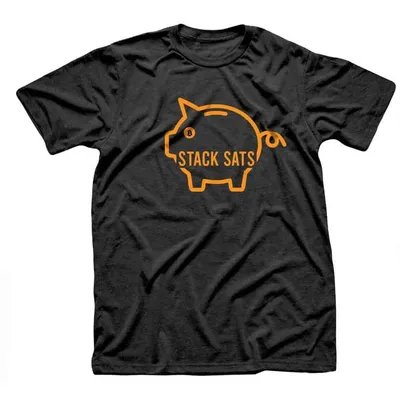
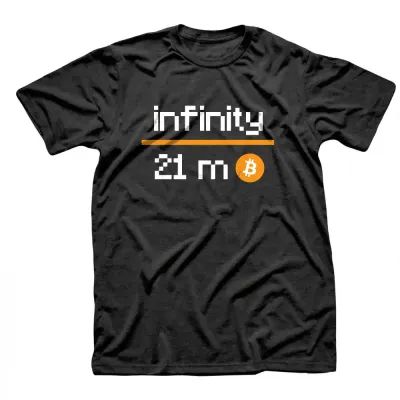
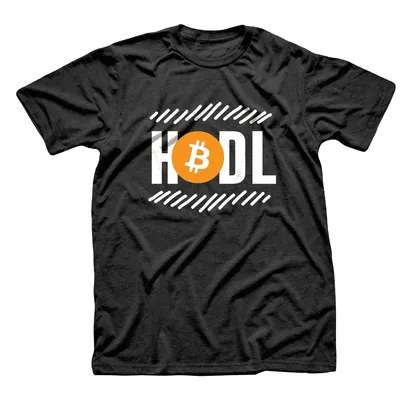
Our Stack Sats tee turns the habit into a cartoon: an orange piggy bank with the slogan right across it, a friendly hint to anyone who counts in sats. If your stacker is also a long-term holder, the HODL tee is the natural partner. And the Infinity / 21M tee puts the supply math on the chest, for people who like the joke behind the numbers.
Sources: the Bitcoin Wiki units page for the unit values and the Bitcoin Wiki on controlled supply for the 21 million limit.