"Running bitcoin" is a two-word tweet that cryptographer Hal Finney posted on January 10, 2009, one week after the bitcoin network went live. Two days later, he received the first bitcoin transaction ever sent from one person to another, 10 BTC from Satoshi Nakamoto.
Those two words have become one of the most loved moments in bitcoin history. This guide covers who Hal Finney was, what happened in those first days, how he faced ALS, and the yearly Running Bitcoin challenge that his wife Fran leads in his memory.
Who was Hal Finney?
Harold Thomas Finney II was born on May 4, 1956, in California, and studied engineering at Caltech. He started out writing video games, then spent much of his career on cryptography, including years of work on PGP, the encryption software that brought strong privacy tools to ordinary people. He was an active member of the cypherpunk community, the group of programmers and activists who believed privacy could be protected with math and code.
In 2004, years before bitcoin, Finney built a system called RPOW, short for reusable proofs of work. It was an early experiment in creating digital tokens backed by computing effort, and it is often mentioned as one of the ideas in the air when bitcoin arrived. So when Satoshi Nakamoto shared the bitcoin design in late 2008, Finney was one of the people best prepared to understand it, and one of the very first to take it seriously.
The Running bitcoin tweet
Satoshi mined the first block, the genesis block, on January 3, 2009. Our genesis block guide tells that part of the story. The software itself was released a few days later, and Finney downloaded it right away.
On January 10, 2009, he posted a short update on Twitter: "Running bitcoin." That's the whole tweet. No hype, no explanation, just a programmer noting what his computer was doing. Looking back, it captures a moment when bitcoin was a tiny experiment run by a handful of people, and he was one of them. Today the phrase shows up on stickers, profile banners and node dashboards as a quiet nod to him.
The first bitcoin transaction
On January 12, 2009, Satoshi sent Finney 10 BTC as a test. The payment was recorded in block 170, and it is generally recognized as the first bitcoin transaction between two different people. Finney also reported bugs and traded emails with Satoshi in those early days, helping a brand new system survive its first weeks.
Years later, Finney wrote a post on BitcoinTalk called "Bitcoin and me" looking back on that period. He described running the software from the start, mining some of the earliest blocks and receiving that first test transaction. It is one of the best first-hand accounts of bitcoin's beginnings, and it is still public. Many people have wondered whether Finney was Satoshi. He always said he was not, and there is no proof that he was. You can read more about that mystery in our guide on who Satoshi Nakamoto is.
Living with ALS
In August 2009, only months after those first transactions, Finney was diagnosed with ALS, a disease that gradually takes away the ability to move and speak. Before his diagnosis he was a keen runner who had completed several half marathons and was training for a full marathon.
He kept working as long as he could. As the illness progressed, he used an eye-tracking system to type and continued writing software and posting online, at a fraction of his old speed. His "Bitcoin and me" post from March 2013 was written that way. It is calm, clear and remarkably upbeat, and it is a good place to meet the man himself.
Hal Finney died on August 28, 2014, at the age of 58. His body was cryopreserved by the Alcor Life Extension Foundation.
The Running Bitcoin challenge
Since 2021, Fran Finney has led the Running Bitcoin challenge in Hal's memory. Participants around the world run, walk, hike or roll 21.1 kilometers (13.1 miles), the half marathon distance that was Hal's favorite, either all at once or a bit at a time. The exact dates have changed from year to year, but the event centers on January, the month of the famous tweet. The 2026 edition ran from January 10, the anniversary of the tweet, through January 31.
Money raised goes to the Hal Finney ALS/MND Research Fund at the ALS Network, supporting research into ALS and related motor neuron diseases. Details and registration are at runningbitcoin.us. It is one of the kindest traditions in bitcoin, and it turns two words from 2009 into something that still helps people today.
Running bitcoin today: what it means to run a node
The phrase also has a practical meaning. Running bitcoin today usually means running a full node: software that downloads the entire blockchain and checks every block and transaction against the rules for itself. People run nodes on old laptops, small home computers and dedicated devices. A node doesn't mine and doesn't earn money. Its job is to verify, so you don't have to trust anyone else's copy of the ledger.
When someone posts a photo of their first node with the caption "running bitcoin," they're echoing Finney on purpose. Same two words, same spirit of joining the network yourself.
A shirt in his spirit
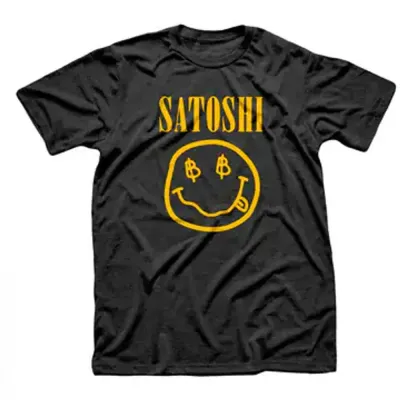
We don't print anyone's likeness for this story. Instead, a few of our tees fit the early-days mood. The Satoshi tee, an independent fan tribute with a bitcoin-eyed smiley, nods to the person who sent that first transaction. The Bitcoin Logo tee is a low-key choice for someone who would rather run a node than talk about it. If you buy one around January, consider pairing it with a donation to the Running Bitcoin challenge. You can browse the full range on our bitcoin apparel page.
Sources: Hal Finney's Bitcoin and me post on BitcoinTalk, Wikipedia on Hal Finney and the ALS Network report on the 2026 Running Bitcoin Challenge.