The first bitcoin transaction between two people was Satoshi Nakamoto sending 10 BTC to Hal Finney, recorded in block 170 on January 12, 2009. Its block timestamp is 03:30:25 UTC that day, which was the evening of January 11 in US Eastern time.
Unlike most history, you do not have to take anyone's word for this. The payment is still sitting in the blockchain, and every detail below can be checked on a block explorer.
What happened in block 170
Block 170 is special for a simple reason: it is the first block in the chain that holds anything besides the miner's own reward. Every block before it, numbers 0 through 169, contains exactly one transaction, the coinbase that pays the miner. Block 170 has two.
The first is the usual coinbase reward of 50 BTC. The second is the payment:
- The input was a 50 BTC reward mined by Satoshi in block 9, which was created on January 9, 2009.
- The first output was 10 BTC, sent to Hal Finney.
- The second output was 40 BTC, which went to another address. That is how change works in bitcoin: an output must be spent whole, so the leftover comes back as a new output.
- The fee was zero. The outputs add up to the full 50 BTC of the input.
The block itself has the hash 00000000d1145790a8694403d4063f323d499e655c83426834d4ce2f8dd4a2ee, and the transaction ID of the payment begins f4184fc5.
Why Hal Finney?
Finney was a cryptographer and a long-time cypherpunk, and he was among the first people to try the software. Our Running Bitcoin and Hal Finney guide tells the story: he posted the two-word message "Running bitcoin" on January 10, 2009, and two days later Satoshi sent him coins.
It is generally described as a test. Satoshi had built the software and needed to see a payment move from one person's wallet to another's, with someone else running the program on the receiving end. Finney was the obvious person for that, and he reported bugs and traded emails with Satoshi in those early days.
The timeline around block 170
It helps to see how few days this took:
- January 3, 2009: Satoshi mines the genesis block, block 0. Our genesis block guide covers the newspaper headline hidden inside it.
- January 9, 2009: Block 1 and the first software release arrive. Block 9 is mined the same day.
- January 10, 2009: Finney posts "Running bitcoin."
- January 12, 2009: Block 170 records the 10 BTC payment.
The wider story, including the white paper before all of this, is in our history of bitcoin timeline.
What a bitcoin transaction is, using this one as the example
Block 170 is a clean example of how every bitcoin payment still works. A transaction points at an earlier output, the coins being spent, and creates new outputs that say who can spend them next. The sender proves the right to spend with a digital signature made by their private key, and nodes on the network check that signature before accepting the payment.
In this case the earlier output was the block 9 reward, and the new outputs were the 10 BTC for Finney and the 40 BTC of change. Nothing else was needed: no bank, no account number and no one approving it. That is the whole point the white paper made, and it is explained step by step in our bitcoin white paper guide.
The payment then had to be placed in a block by a miner, which is how it became part of the permanent record, a process our guide to what a bitcoin block is covers.
What happened to the coins afterward
The 10 BTC did not sit still forever. According to the blockchain, the output was spent in block 92,240, with a timestamp of November 16, 2010 UTC. The 40 BTC change output was spent much sooner, in block 181, just a few hours after block 170.
Neither detail changes the history. It simply shows the early network being used the way anyone uses money, with coins coming in and going out.
How to see block 170 yourself
You do not need an account or special software:
- Open any block explorer, such as mempool.space or blockstream.info.
- Type 170 into the search bar.
- Open the block and look at its two transactions.
- Click the second one and you will see one input and two outputs, 10 BTC and 40 BTC.
The explorer will show the block time in your own time zone or UTC, depending on the site. If the date looks off by a day, that is the 03:30 UTC timestamp falling on the previous evening in the Americas.
A small caveat on "first"
When people say first bitcoin transaction, the careful version is the first transaction between two different people that appears on the public blockchain. Before that, the only entries are miners' rewards. The blockchain can only show what was broadcast to the public network, so it says nothing about whatever testing Satoshi did privately before launch, and the history books reflect that gap.
The tees that nod to it
A few of our designs sit close to this moment in history:
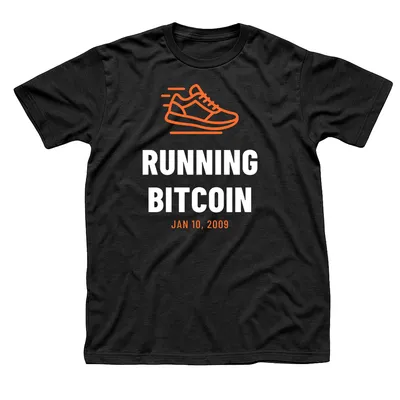
- The Running Bitcoin tee draws an orange running sneaker with speed lines above the words RUNNING and BITCOIN, with JAN 10, 2009 in small type underneath, the day Finney's tweet appeared.
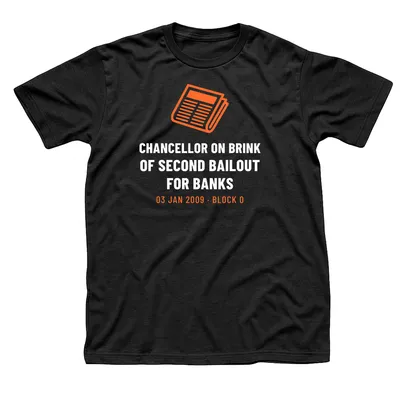
- The Genesis Block tee prints the Times headline from block 0 beneath an orange folded newspaper, the start of the chain that block 170 sits on.
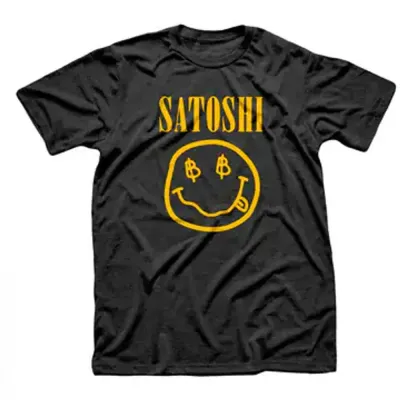
- The Satoshi Smiley tee, an independent fan tribute and not affiliated with anyone, lettered in yellow above a bitcoin-eyed smiley, is for the person who sent the coins.
You will find more in the bitcoin history shirts collection.
Sources: block 170 and transaction data as shown on the blockstream.info block explorer, plus our own Running Bitcoin guide.